






How Vacuum Insulation Works — The Science Behind Thermos® Products
When people ask why a Thermos® bottle keeps drinks cold for 24 hours or hot coffee drinkable for 12 — even sitting in direct sunlight or a hot car — the answer is physics. Specifically, it's the result of removing one of the three mechanisms through which heat moves. Once you understand the science, you also understand why not all insulated bottles are equal, why the word "vacuum" matters, and what separates a bottle that genuinely performs from one that just claims to.
Thermos® invented vacuum insulation in 1904. More than 120 years later, the principle is exactly the same — because the physics hasn't changed.
The Three Ways Heat Moves
Heat is constantly trying to equalize — moving from warmer areas to cooler ones. It does this in three distinct ways. To understand vacuum insulation, you need to understand all three, because a well-engineered bottle must address all of them simultaneously.
● Conduction: Heat travels through direct contact between materials. Touch a hot pan and heat conducts through the metal directly into your hand. In a single-wall stainless steel bottle, heat conducts from the warm exterior through the metal wall directly into your cold drink — warming it up within an hour or two.
● Convection: Heat transfers through the movement of a fluid or gas. This is why a room with air circulation feels cooler on a hot day, and why heat rises. In a bottle with air trapped between two walls, the air itself circulates and carries heat between the outer and inner walls.
● Radiation: Heat travels as infrared electromagnetic energy — without needing any medium at all. The sun heats the Earth across 93 million miles of empty space through radiation. A bottle sitting in direct sunlight absorbs radiant heat through its exterior walls.
A bottle that truly keeps drinks at temperature needs to address all three mechanisms. Most budget insulated products address one or two. Genuine double-wall vacuum insulation addresses all three.
What "Vacuum Insulated" Actually Means
A vacuum-insulated bottle is built with two walls — an inner wall that holds your drink and an outer wall that faces the environment. The space between those two walls is not filled with air. It's evacuated — meaning the air is removed to create a near-vacuum.
This is where the science becomes elegant. A vacuum has almost no molecules. With no molecules:
● Conduction is essentially eliminated — there's no solid material bridging the two walls (only a small support structure at the base and top, which is carefully minimized).
● Convection is eliminated — there's no air to circulate and carry heat.
● Radiation is significantly reduced — the inner walls of high-quality vacuum bottles are polished to a reflective finish, which reflects infrared radiation back rather than absorbing it.
The result: a bottle that is thermally isolated from its environment. Your cold drink stays cold because heat from outside has almost no way to reach it. Your hot drink stays hot because heat from inside has almost no way to escape.
Vacuum Insulated vs Double-Wall Air-Gap: What's the Difference?
These two terms look similar on packaging but perform very differently. This is one of the most important distinctions to understand when evaluating any insulated bottle.
● Double-wall air-gap: Two walls with regular air trapped between them. Air is a better insulator than a single wall of metal alone — but air still conducts some heat and convects significantly. Drinks typically stay cold for 3–6 hours. The exterior often feels cool or slightly cold to the touch, indicating heat is still transferring.
● Double-wall vacuum: Two walls with the air removed. As described above, the vacuum eliminates conduction and convection between the walls, and the reflective inner surface reduces radiation. Drinks stay cold for up to 24 hours and hot for up to 12. The exterior stays at room temperature regardless of what's inside — no condensation, no sweating.
The sweat test is a reliable quick check: hold a cold-liquid-filled bottle. If moisture forms on the exterior, the bottle is not true vacuum insulated. In a properly vacuum-insulated bottle, the outer wall stays completely dry because no heat is transferring through the vacuum to cause condensation.
All Thermos® vacuum-insulated products use genuine double-wall vacuum technology — the same fundamental construction Thermos® pioneered in 1904.
Why 18/8 Stainless Steel Is the Right Material
The construction of the walls themselves also matters. Thermos® vacuum-insulated products use 18/8 stainless steel — the grade designation refers to its composition: 18% chromium and 8% nickel.
● Corrosion resistance: Chromium creates a passive oxide layer that prevents rust and corrosion, even with repeated contact with acidic drinks like coffee, juice, or sports drinks.
● No flavor transfer: Unlike plastic or some cheaper metals, 18/8 stainless steel is non-reactive — it doesn't impart any metallic taste to drinks, even after extended storage.
● Structural integrity: The density and tensile strength of 18/8 stainless steel allows walls to be manufactured thin enough to minimize the heat-bridging contact points at the top and base, while remaining durable enough to handle the pressures of daily use.
● Temperature neutrality: Stainless steel has relatively low thermal conductivity compared to other metals — it's less prone to conducting heat through the minimal contact points at the bottle's structure.
How Thermos® Tests Thermal Performance
Every thermal performance claim made by Thermos® — 24 hours cold, 12 hours hot, 7 hours hot — is the result of standardized testing conducted under controlled laboratory conditions, not marketing estimates.
The testing protocol involves filling a bottle at a specific starting temperature, sealing it, and measuring the contents at defined intervals in a controlled ambient temperature environment. The published numbers represent the minimum performance — what the bottle achieves under the specified test conditions. Real-world performance often exceeds the published figures, particularly in cooler environments or when the bottle is pre-treated before filling.
Pre-treating matters: filling a bottle with hot water for a few minutes before adding hot liquid — or cold water with ice before adding a cold drink — primes the inner wall temperature and can add hours to effective performance.
Why the Thermos® Name Has Meant Vacuum Insulation for Over a Century
Thermos® has been synonymous with vacuum insulation for so long because Thermos® invented the technology, scaled it for consumer use, and built a reputation over generations of consistent performance.
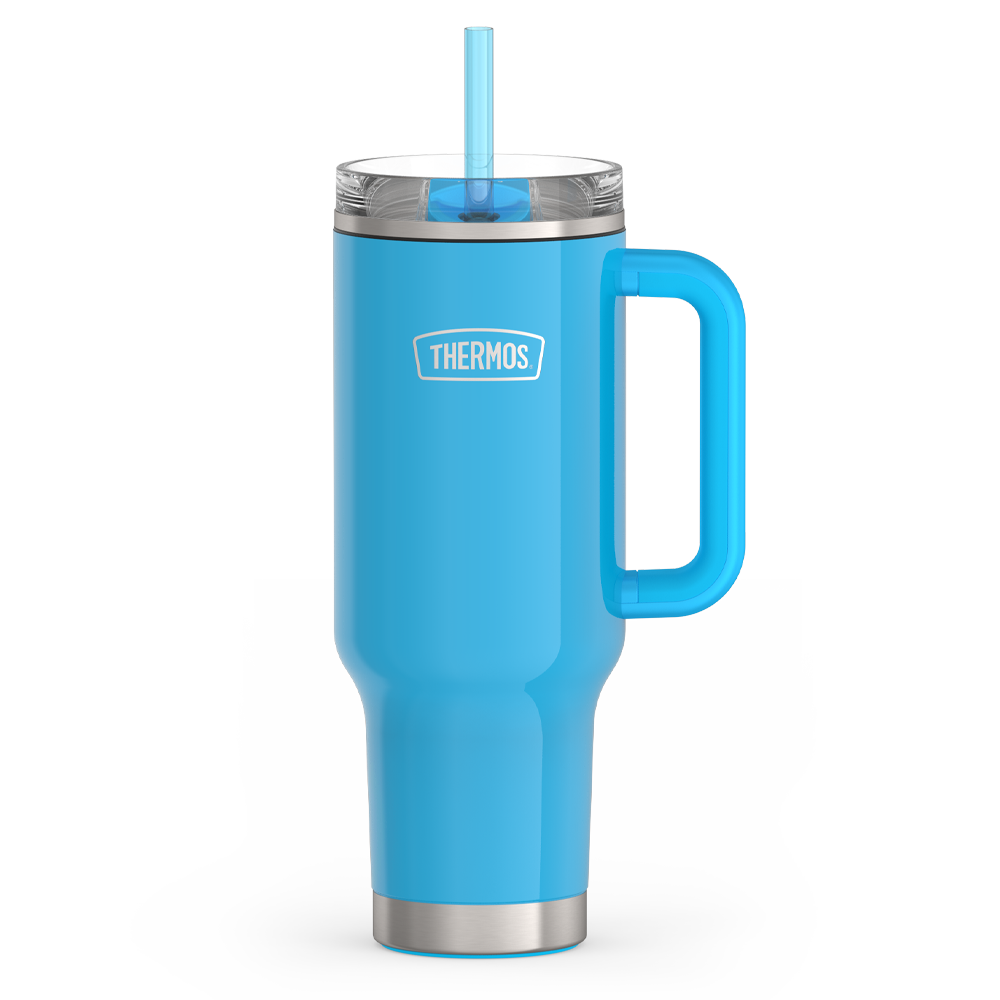
The Thermos® Icon™ Series, Stainless King™ collection, and FUNtainer® line all use the same fundamental vacuum insulation technology — refined through 120 years of engineering improvements. The science is the same. The materials are better. The manufacturing tolerances are tighter.
Explore the full Thermos® vacuum-insulated product line at thermos.com/pages/drinkware
Explore the full Thermos® vacuum-insulated range at thermos.com/pages/drinkware — from the Icon™ Series at thermos.com/pages/icon-series and Stainless King™ collection at thermos.com/collections/stainless-king-collection-2, to FUNtainer® kids bottles at thermos.com/collections/funtainer and custom laser-engraved products at thermos.com/collections/customize.
Frequently Asked Questions
What is the difference between vacuum insulated and double-wall insulated?
Double-wall insulated means a bottle has two walls, but those walls may have air — or sometimes foam — between them. Vacuum insulated means the air between the two walls has been removed to create a near-vacuum. The vacuum eliminates both conduction and convection between the walls, dramatically outperforming air-gap double-wall construction. A vacuum-insulated bottle typically keeps drinks cold 4–6x longer than an air-gap double-wall bottle.
How long do vacuum-insulated bottles actually keep drinks cold?
Under standardized test conditions and depending on the capacity, Thermos® vacuum-insulated bottles keep drinks cold for up to 24 hours. Real-world performance depends on starting temperature, how often the lid is opened, and ambient temperature. A bottle pre-chilled with ice water before filling will perform better than one filled at refrigerator temperature without pre-treatment.
Why does my insulated bottle sweat on the outside?
Condensation on the outside of an insulated bottle means the outer wall is getting cold — which only happens if heat is transferring from outside to inside (or cold is transferring outward). In a properly sealed vacuum-insulated bottle, the outer wall stays at room temperature regardless of contents, and no condensation forms. Sweating is a reliable indicator that the vacuum seal has been compromised, typically from a significant drop or impact.
Does vacuum insulation work for both hot and cold drinks?
Yes — the vacuum creates thermal isolation in both directions. Heat from outside cannot efficiently enter the bottle (keeping cold drinks cold) and heat from inside cannot efficiently escape (keeping hot drinks hot). The same vacuum that keeps your ice water cold on a 90-degree day keeps your coffee hot on a winter commute.
How does Thermos® vacuum insulation compare to competitors?
Thermos® invented double-wall vacuum insulation for consumer products in 1904 and has continuously refined the technology. Thermos® products are tested to specific thermal performance standards and the published performance claims (24 hours cold, 12 hours hot, etc.) reflect standardized lab testing, not estimates. The 18/8 stainless steel construction and reflective inner walls are consistent across the product line, from the FUNtainer® bottle to the Stainless King™ beverage bottle.